
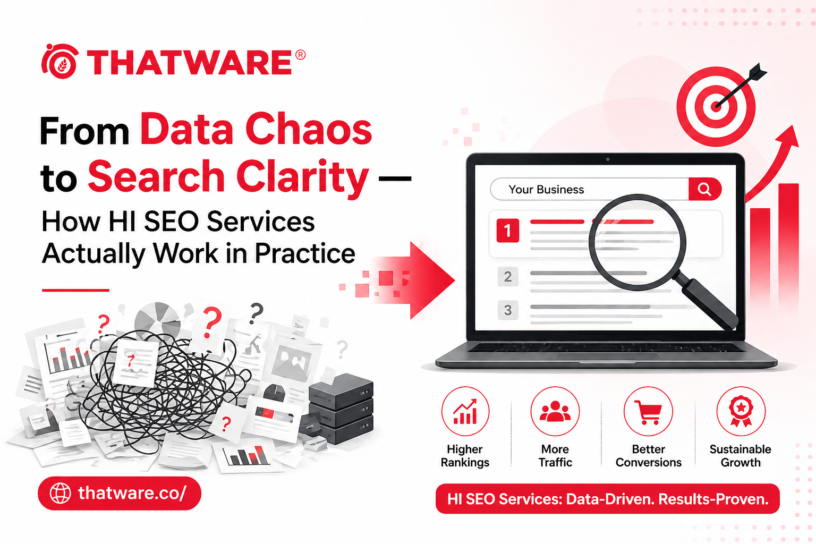



Ask most marketing teams to describe their SEO data environment and you get variations of the same answer. Google Search Console in one tab. Analytics in another. A rank tracker running in a third. An SEO platform – Ahrefs, Semrush, something else – open somewhere. A content performance spreadsheet that someone built six months ago and is now partially outdated. Reports from the agency in a slide deck that nobody’s opened since last month.
Data is everywhere. Understanding is harder to find.
The gap between data availability and actionable insight is one of the most common – and most expensive – problems in SEO. Businesses aren’t short of information about their search performance. They’re short of the analytical infrastructure that connects those data streams into a coherent picture of what’s working, what isn’t, and what to do next. Hyper-Intelligence SEO services exist, in significant part, to close that gap.
The Data Fragmentation Problem
Every major SEO data source captures a different slice of the picture, and none of them fully agrees with the others.
Google Search Console shows impressions and clicks from Google’s perspective – but it’s sampled, delayed, and doesn’t tell you why rankings changed, only that they did. Analytics shows user behavior on-site but doesn’t directly connect to search performance in the ways that matter for optimization decisions. Third-party rank trackers show keyword position data but can vary in accuracy and don’t capture the full range of search features (featured snippets, AI Overviews, local packs) where visibility actually lives. Crawl data shows technical health but requires interpretation to prioritize what matters.
The typical SEO practitioner spends significant time just reconciling data from these systems – manually checking one against another, trying to construct a coherent narrative from inconsistent inputs. This is time not spent on actual optimization.
Hi seo services that work build an integrated analytical layer on top of these sources – not replacing them, but connecting them in ways that surface insights that none of them surfaces independently.
What Intelligence Means Beyond Reporting
There’s a difference between reporting and intelligence that’s worth making explicit. Reporting tells you what happened. Intelligence tells you what it means, why it happened, and what to do about it.
Standard SEO reporting: “Organic traffic is up 12% month-over-month. Keywords in positions 1-3 increased by 8. Three new featured snippets were captured.”
SEO intelligence: “The 12% traffic increase is concentrated in three category clusters that received content updates in Q3. The featured snippet gains are in queries with AI Overview presence – suggesting these content pieces are well-optimized for direct-answer formats. The 8 new top-3 keyword positions coincide with a competitor’s site migration that appears to have created temporary authority disruption. The opportunity window is approximately 60-90 days before they recover, and priority should be extending content coverage in the three clusters where they were strongest.”
The second version requires integrating more data, understanding more context, and applying more analytical judgment. It produces different – and significantly more valuable – decisions.
HI SEO in Practice: The Analytical Workflow
What does this actually look like day-to-day? A rough picture of the intelligence workflow in a functioning HI SEO engagement.
Continuous monitoring surfaces anomalies – ranking changes that exceed normal variance, traffic shifts that don’t correlate with expected patterns, competitor movements, technical changes in Googlebot crawl behavior. Most of this monitoring runs automatically, with flagging thresholds that surface the signals requiring human attention without drowning analysts in noise.
Anomaly interpretation applies context. A sudden ranking drop in a specific content cluster might indicate a relevance change in how Google is interpreting those queries, a technical issue affecting those specific pages, a competitor improvement, or an algorithmic shift. The monitoring tells you the drop happened. The intelligence layer explains which explanation is most likely, based on corroborating signals from other data sources.
Strategic prioritization turns interpretation into action. Given everything the data is showing – where the opportunities are, what the constraints are, how competitor positions are evolving – what’s the highest-leverage investment for the next 30 days? This question gets answered from the integrated intelligence picture, not from any single data source.
The Role of AI in HI SEO Data Processing
Ai driven seo intelligence services lean on machine learning and AI specifically for the parts of the analytical workflow that benefit from processing large data volumes quickly.
Pattern recognition across large keyword sets: identifying which topic clusters are building momentum, which are declining, and which are showing competitive vulnerability – across hundreds or thousands of keywords simultaneously – is a task AI handles well. A human analyst can interpret these patterns once they’re surfaced; finding them in the first place benefits from machine processing.
Content quality assessment at scale: evaluating which content pieces in a large library are meeting quality standards, which have degraded due to age and outdated information, and which have the structural characteristics associated with AI search visibility is analytically intensive work that AI tools can automate meaningfully.
Competitive intelligence synthesis: tracking content publication, ranking changes, and authority building across multiple competitors simultaneously and synthesizing that information into coherent competitive intelligence is another area where AI assistance produces more comprehensive analysis than manual tracking would.
The human role in all of these is interpretation, judgment, and decision-making. AI processes the data. Experienced SEO practitioners decide what it means and what to do about it.
From Chaos to Clarity: The Practical Outcome
The practical outcome of a functioning HI SEO approach is that marketing leadership gets to make decisions from a coherent, integrated picture of search performance rather than from fragments of data that tell different stories.
Monthly strategic decisions – where to invest content resources, which technical projects to prioritize, where to focus link acquisition – are made from confident analytical grounding rather than from gut feel or from whichever data source was most recently reviewed. Problems are caught earlier because the monitoring infrastructure sees across more dimensions than manual review would. Opportunities are identified faster because the pattern recognition layer isn’t limited by the bandwidth of the analyst team.
For brands that have been operating in data chaos – watching multiple dashboards and feeling like they still don’t really know what’s happening – this shift in analytical clarity is often as valuable as any specific tactical improvement. Understanding what’s working and what isn’t, reliably and early, changes the quality of every decision downstream. That’s what intelligence, applied to SEO, actually produces.
AI Ranking Optimization for E-commerce Brands: Selling in a World Where AI Curates Results
Something has shifted in how e-commerce discovery works, and brands that are still measuring success purely by Google Shopping position or organic product page rankings are working with an incomplete map. A growing portion of product research journeys now involve an AI intermediary – someone asking ChatGPT what the best product in a category is, using Perplexity to compare options, getting a summarized recommendation from Google’s AI Overviews – and the brands that appear in those AI-curated recommendations are reaching buyers at a different point and through a different mechanism than traditional search optimization addresses.
This doesn’t mean traditional e-commerce SEO is irrelevant. Rankings still drive traffic. Product pages still need to convert. Organic search remains a major channel. But the discovery layer is expanding, and brands optimizing only for the traditional layer are leaving meaningful visibility on the table.
How AI Systems Approach Product Recommendations
Understanding why AI ranking optimization matters for e-commerce requires understanding how AI systems actually evaluate and recommend products.
Language models draw on their training data – which includes product reviews, category guides, expert recommendations, editorial content, and countless Q&A conversations about what products to buy. When someone asks “what’s the best budget mirrorless camera for beginners,” the model’s recommendation is shaped by which products have been discussed positively and authoritatively across all of those sources. It’s not checking real-time prices or inventory. It’s synthesizing the reputation and authority signals that have accumulated around specific products and brands.
This creates a specific kind of optimization target: you’re not trying to rank a page, you’re trying to ensure that your brand and products have been discussed and represented positively in the sources that AI systems draw from. That’s a different challenge from technical SEO, though there’s meaningful overlap.
The Review Ecosystem Matters More Than You Think
For e-commerce specifically, reviews are the most significant lever for AI recommendation presence. Not just on your own site – across the full ecosystem of third-party review platforms, category guides, comparison sites, and editorial publications where products in your category are discussed.
AI models trained on internet content have absorbed enormous amounts of review data. Products with substantial, positive, specific review presence across multiple credible platforms are more likely to be recommended by AI systems than products with limited or concentrated review presence (like only positive reviews on your own site, which carries less weight as an independent signal).
Ai ranking optimization services for e-commerce include systematic review ecosystem development – not fake reviews, but structured programs to expand genuine review presence across the platforms that matter for your category. Amazon reviews, Google reviews, Trustpilot, category-specific review sites, editorial publications that cover your product type – each of these contributes to the AI-accessible evidence base about your brand and products.
Product Content Structured for AI Extraction
The content on your product pages and category pages should be structured in ways that make it easy for AI systems to extract and use accurately. This is different from – though overlapping with – traditional SEO optimization.
Direct answerable claims are key. “This camera weighs 450g and captures 4K at 60fps” is extractable by AI in a way that “this camera delivers professional-quality video in a remarkably compact form factor” is not. Specific, concrete, factually precise product descriptions are better for AI extraction than marketing language that’s technically accurate but interpretively vague.
Structured data – specifically Product schema with all relevant attributes marked up – helps AI systems understand product characteristics, pricing, availability, and categorization without needing to interpret unstructured text. Schema markup that’s complete and accurate is foundational AI optimization for e-commerce.
FAQ sections on product and category pages, structured with FAQ schema, are particularly valuable because the Q&A format directly matches how AI systems often receive and respond to queries. A product page with a well-written FAQ section answering the questions buyers commonly ask is much more AI-citation-friendly than one that buries that information in flowing product description text.
The Category Authority Layer
Beyond individual product representation, e-commerce brands benefit from building category-level AI authority – becoming the brand that AI systems recognize as a credible source on topics related to what you sell.
A brand selling running shoes that publishes genuinely authoritative content about running training, injury prevention, and footwear selection isn’t just doing content marketing. They’re building the topical authority signals that make AI systems more likely to reference their products when answering running-related questions. The AI perceives them as a knowledgeable source in the running category, not just a store that sells shoes.
Ai visibility optimization services for e-commerce that address this category authority layer help brands build the editorial presence that makes AI systems confident citing them. This is a longer-term investment than product-level optimization, but it produces broader and more durable AI visibility.
Measuring AI Visibility for E-commerce Brands
Measurement is still evolving in this space, but there are practical approaches that provide useful signal.
Manual testing at scale: systematically querying major AI platforms with the product research questions your target customers ask, documenting which brands and products appear, and tracking your presence over time. This can be done systematically with defined query sets and regular testing cycles.
Traffic pattern analysis: branded search volume is a useful proxy for AI-driven discovery. When someone encounters your brand in an AI recommendation and later searches for you directly, that shows up as branded search. Tracking branded search volume alongside AI optimization efforts provides indirect evidence of AI visibility impact.
Third-party tool monitoring: a growing number of tools are specifically tracking brand mention frequency in AI-generated responses. These are imperfect but improving, and the directional signal they provide is worth having even if absolute accuracy is limited.
The Window That’s Still Open
Here’s the honest assessment of where AI visibility optimization stands for e-commerce in 2026: most e-commerce brands are not systematically investing in it. The brands that are building AI-optimized product content, developing their review ecosystem intentionally, and building category authority are doing so in an environment where most competitors aren’t paying attention to this layer yet.
That creates a first-mover advantage that will close as awareness increases and competition catches up. Brands that establish strong AI recommendation presence now – across the product categories and buyer questions that matter to them – are building a visibility foundation that will compound as AI-mediated search continues to grow in importance.
The brands that wait for this to become standard practice will find themselves building from behind in an environment where the early movers have compounding advantages. That pattern has repeated itself throughout the history of search optimization. The brands that learn from it rather than repeating it tend to do considerably better.




Leave a Reply
You must be logged in to post a comment.